Buying a Dermatoscope: The Complete Guide for Clinicians
Different dermatoscopes perform very differently. Optics, illumination, polarization, and digital features can significantly impact diagnostic clarity, workflow efficiency, and patient documentation. That’s why buying a dermatoscope shouldn’t be guesswork—your device should align with your clinical needs.
4 min read
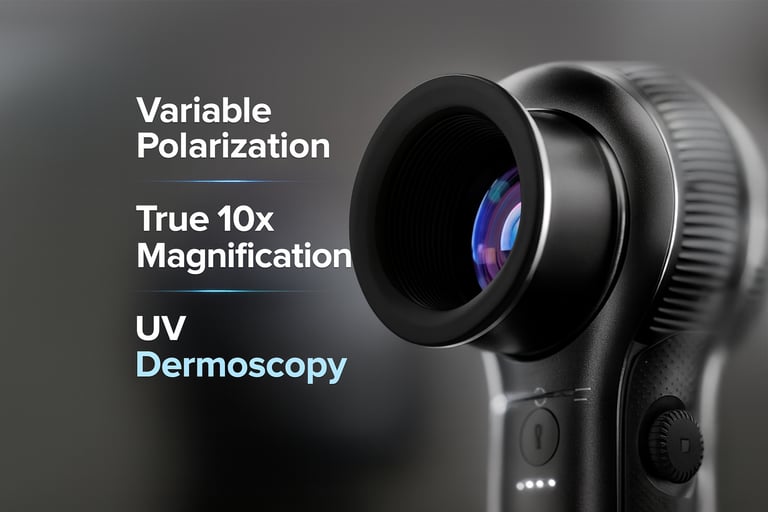
If you’re buying a dermatoscope, this guide gives you everything you need to choose the right device confidently—whether you’re a dermatologist, PCP, PA, NP, or medical student.
What Is a Dermatoscope — and Why Choosing the Right One Matters
A dermatoscope is a handheld device that uses magnification and specialized lighting to reveal subsurface skin structures. It helps clinicians see pigment networks, vascular patterns, and morphological details that aren’t visible to the naked eye.
Different dermatoscopes perform very differently. Optics, illumination, polarization, and digital features can significantly impact diagnostic clarity, workflow efficiency, and patient documentation. That’s why buying a dermatoscope shouldn’t be guesswork—your device should align with your clinical needs.
Understanding Search Intent: What Clinicians Want When Buying a Dermatoscope
Healthcare professionals in the US typically search for:
Which dermatoscope to buy for general practice or dermatology
Differences between analog and digital models
What magnification and lighting actually matter
Whether polarized or non-polarized modes are necessary
Which features improve diagnostic accuracy
What to consider before investing in a high-end dermoscopy device
This guide covers all of these sub-intents in a single, comprehensive resource.
Key Factors to Consider Before Buying a Dermatoscope
1. Clinical Use-Case
Think first about how you plan to use the dermatoscope:
General primary care: A high-quality analog dermatoscope is usually sufficient.
Dermatology practice: Hybrid models with better optics and dual lighting modes offer versatility.
Advanced dermatology or skin cancer clinics: Digital dermatoscopes with imaging capabilities add value.
Teledermatology & remote consultations: Image capture, smartphone connectivity, and digital documentation are essential.
Training & education: Devices with strong optical clarity or digital display features help with teaching.
2. Magnification & Field of View
Most clinicians work with 10× magnification, but for detailed evaluation of pigmented lesions, higher magnification (15×–20×) offers sharper visualization of pigment networks and vascular structures.
A wider field of view can also improve accuracy by showing lesion context rather than isolating tiny sections of skin.
3. Lighting & Polarization
Light quality is one of the most important variables.
Polarized light filters out surface glare and reveals deeper structures like pigment networks and vascular patterns.
Non-polarized light (with immersion fluid) highlights superficial details such as scales or follicular openings.
Dual-mode dermatoscopes (polarized + non-polarized) offer maximum flexibility.
Most modern scopes use bright, energy-efficient LED illumination, which produces clear, consistent lighting suitable for clinical environments.
4. Analog vs Digital Dermatoscopes
Analog dermatoscopes:
Simple, reliable, lightweight
Ideal for general exams, students, and low-volume use
No image capture or storage
Digital dermatoscopes:
Capture high-resolution images for follow-up, teledermatology, referrals, or EHR integration
Compatibility with smartphones or dedicated cameras
Perfect for dermatology practices handling complex pigmented lesions
If your workflow includes documentation, digital may become essential rather than optional.
5. Ergonomics & Portability
Consider the physical feel of the device:
Is it comfortable to hold for long sessions?
Is the weight balanced?
Is it too bulky for fieldwork or mobile clinics?
Does it offer rechargeable power rather than disposable batteries?
In the US, clinicians often move between exam rooms or telehealth setups—portability matters more than you might expect.
6. Build Quality, Durability & Support
A dermatoscope is a long-term clinical tool, and durability matters:
Opt for strong housings (metal or reinforced polymer)
Prioritize scratch-resistant lenses
Look for reputable US distributors with strong warranties
Confirm available support, parts, and customer service
Equipment failure during clinic hours is costly—support matters as much as specs.
7. Accessories & Add-Ons
Depending on the model, you may also need:
Immersion fluid or gel (for non-polarized mode)
Cleaning equipment
Smartphone adapters (for digital models)
Protective cases
Replacement contact plates or caps
Checking what’s included versus what must be purchased separately helps control long-term ownership costs.
How to Decide: A Simple Step-by-Step Buyer’s Checklist
Before you finalize your purchase, answer these:
Do I need digital imaging, or is optical-only fine?
Will I use polarized, non-polarized, or both lighting modes?
How often will I use the dermatoscope?
Do I perform many follow-up exams that require documentation?
Am I working in multiple locations where portability is important?
What features matter most in my clinical workflows?
Do I require compatibility with EHR, telederm software, or smartphones?
Do I want a device suitable for teaching or group demonstration?
Your answers will point clearly toward analog, hybrid, or fully digital dermatoscopes.
Common Trade-Offs When Choosing a Dermatoscope
Analog Dermatoscope
Pros: Lightweight, simple, affordable, reliable
Cons: No imaging, less useful for documentation or teledermatology
Hybrid Dermatoscope
Pros: Better optics, dual lighting modes, optional smartphone connectivity
Cons: Slightly heavier, higher learning curve
Digital Dermatoscope
Pros: HD images, telederm-ready, ideal for follow-up and referrals
Cons: More expensive, may require additional software or accessories
The right choice depends entirely on your workflow, not on purchasing the highest-tier model available.
Who Should Buy Which Type of Dermatoscope?
Medical students & residents: Analog dermatoscopes are excellent for building foundational skills.
Primary care providers: Hybrid scopes offer clinical flexibility without unnecessary complexity.
Dermatologists: Digital dermatoscopy provides the imaging required for pigmented lesion monitoring.
Teledermatology practices: Digital scopes with smartphone or camera integration are ideal.
Educators & researchers: Models that support image sharing or live display are most effective.
Buying a Dermatoscope: What to Know Before You Order
Here are practical considerations US buyers often overlook:
Ask for sample images (from both polarized and non-polarized modes).
Compare optic quality across manufacturers, not just magnification numbers.
Verify US-based warranty and repair services.
Ensure compatibility if using smartphone mounts or imaging systems.
Check weight and grip ergonomics—comfort affects daily use.
Confirm return policies in case the device doesn’t fit your workflow.
Buying a dermatoscope is a long-term clinical investment—these small checks go a long way.
FAQ — Buying a Dermatoscope
Q: Is an analog dermatoscope good enough for general use?
Yes. For routine skin exams, screenings, and general practice, a quality analog dermatoscope is often sufficient and highly reliable.
Q: Do I need polarized light?
Polarized light is extremely useful for viewing deeper structures and pigmented lesions. Dual-mode devices (polarized + non-polarized) offer maximum flexibility.
Q: Should I invest in a digital dermatoscope?
If you document lesions, teach, or participate in teledermatology, digital is worth it. If you only need visual assessment during appointments, analog may be enough.
Q: What magnification is best?
10× is the standard, but 15×–20× can be helpful for dermatologists focusing on pigmented lesions and vascular patterns.
Q: Do I need additional accessories?
Possibly—immersion fluid, protective covers, smartphone adapters, or cleaning supplies, depending on the model.
Conclusion
When buying a dermatoscope, the best choice depends on your clinical environment, documentation needs, lighting preferences, and workflow. Analog scopes are excellent for routine assessments, hybrid scopes strike a balance between versatility and simplicity, and digital scopes provide advanced imaging for follow-up, referrals, and teledermatology.
A dermatoscope is one of the most frequently used diagnostic tools in dermatology and primary care, so choosing the right one ensures accuracy, comfort, and long-term reliability.
Expert Insight
As someone with extensive experience advising medical clinics and dermatology practices on equipment selection, I’ve found that clinicians often overestimate the need for advanced features. Start by identifying what you actually do daily—screening, follow-up imaging, pigmented lesion evaluation, or telederm. Once your use-case is clear, selecting the right dermatoscope becomes easy and cost-effective.
Stay Updated, Latest News
This website contains affiliate links, and we may earn a commission at no extra cost to you.